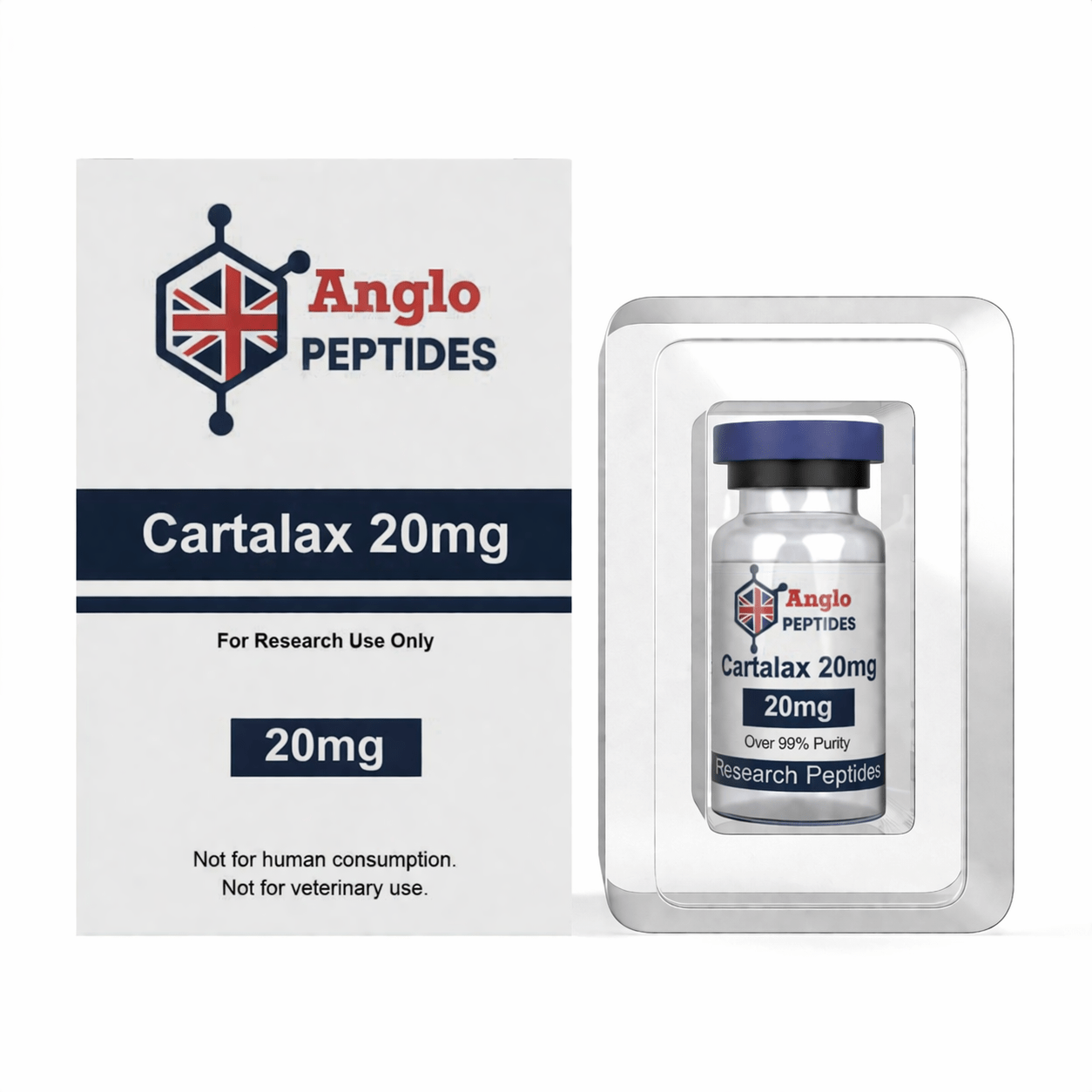
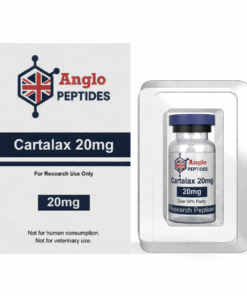
Cartalax UK – Short Peptide Research Material
Anglo Peptides provides
Cartalax as a research-focused peptide material for
legitimate laboratory and scientific investigation. Also identified as
Ala-Glu-Asp (AED), this short synthetic tripeptide has appeared in
research concerning peptide biology, gene-expression regulation and
cellular ageing models.
Its scientific interest comes from the broader study of short peptides
and their potential interactions with cellular regulatory processes.
Researchers investigating connective-tissue biology, cellular
differentiation and peptide-mediated signalling may therefore find this
material relevant to exploratory laboratory work.
This product is supplied for research purposes only. The information
below is intended to provide scientific context and product guidance,
rather than medical or therapeutic advice.
What Is Cartalax?
Cartalax is the commonly used name associated with the short peptide
alanyl-glutamyl-aspartic acid, also known as
Ala-Glu-Asp or AED. The National
Library of Medicine lists Cartalax as an entry term for
alanyl-glutamyl-aspartic acid, while PubChem records the compound as a
tripeptide with the sequence AED.
Its small peptide structure makes it useful for research examining the
relationship between peptide sequence, molecular recognition and
biological signalling.
Researchers can verify the compound’s chemical identity and synonyms
using the
PubChem record for alanyl-glutamyl-aspartic acid
.
Cartalax Research Background
Research surrounding this short peptide is associated with the broader
Khavinson short-peptide bioregulator programme. Published work from this
research tradition has investigated short peptides in connection with
gene-expression regulation, protein synthesis and age-related cellular
changes.
Some literature has also associated the compound with cartilage and
connective-tissue research. However, the strength of evidence varies
considerably between research areas, and findings from experimental
models should not be interpreted as proof of clinical efficacy.
This distinction is particularly important when evaluating commercial
descriptions of experimental peptides. Laboratory observations can help
identify biological pathways worth studying without establishing a
validated treatment or clinical application.
Cartilage and Connective-Tissue Research
One area frequently associated with this peptide is cartilage biology.
Cartilage contains a specialised extracellular matrix maintained by
chondrocytes, collagen, proteoglycans and other structural components.
Research into peptide-based approaches to cartilage biology has expanded
considerably, with scientists investigating molecules capable of
interacting with extracellular-matrix components and cellular signalling
pathways.
A 2024 review indexed by PubMed examines the wider field of
peptides investigated for chondrogenic induction and cartilage
regeneration
.
This broader research context is useful when assessing short peptides
associated with cartilage research, but it should not be interpreted as
evidence that every peptide discussed in the literature produces the
same biological outcome.
Short Peptides and Cellular Biology
Short peptides are attractive research subjects because their relatively
small size allows scientists to investigate highly specific sequence
relationships and molecular interactions.
The research literature surrounding the Khavinson peptide programme has
explored whether short sequences can influence cellular processes such as
gene expression and protein synthesis.
These investigations provide a useful framework for studying how small
peptide sequences may interact with biological regulatory systems.
However, proposed mechanisms should be assessed against independently
reproduced experimental evidence.
Cartalax and Gene-Expression Research
Gene-expression research is another area relevant to the scientific
discussion surrounding this material.
Studies within the short-peptide bioregulator field have examined changes
in gene expression and cellular function following exposure to selected
peptide sequences. These experiments are relevant to researchers
investigating relationships between peptide structure and cellular
regulation.
It is important to distinguish changes observed in cultured cells from
effects demonstrated in animals or humans. Each research model answers
different scientific questions and has its own limitations.
Research Evidence
The available literature should be interpreted carefully. Much of the
discussion surrounding this compound comes from the short-peptide
bioregulator research tradition, while independent confirmation of
specific biological claims is comparatively limited.
Current research indexes identify experimental and review literature
involving the compound and related short-peptide systems. The evidence
base should therefore be regarded as exploratory rather than equivalent
to the evidence supporting an established pharmaceutical.
Researchers should examine the original study design, experimental model,
peptide identity and analytical methods before drawing conclusions from
published findings.
Cartalax Research Areas
Current scientific interest surrounding this material includes several
areas of peptide and cellular research:
- Short-peptide biology
- Cartilage and connective-tissue research
- Chondrocyte biology
- Extracellular-matrix research
- Gene-expression studies
- Cellular ageing research
- Protein synthesis research
- Peptide-mediated signalling
These categories describe research interests and should not be regarded
as approved therapeutic indications.
Cartalax UK Product Information
Researchers searching for Cartalax UK should review the
exact product specifications supplied with the material before beginning
laboratory work.
Important considerations can include peptide identity, stated quantity,
formulation, product presentation and storage information where
applicable.
Researchers should verify that the material is suitable for their
intended experimental procedures and use appropriate analytical and
laboratory controls.
For information about fulfilment and delivery, visit the
Anglo Peptides Shipping Policy
.
Why Product Characterisation Matters
Reliable peptide research depends on knowing precisely what material is
being investigated. Peptide identity, purity, formulation and storage
can all influence experimental results.
PubChem identifies the compound associated with this name as
alanyl-glutamyl-aspartic acid, with the molecular formula
C12H19N3O8 and a reported
molecular weight of 333.29 g/mol.
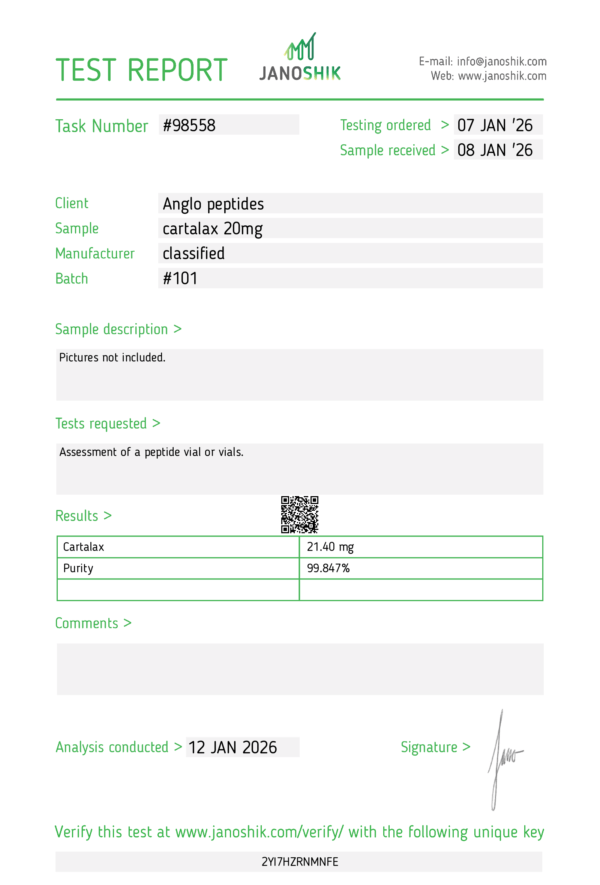
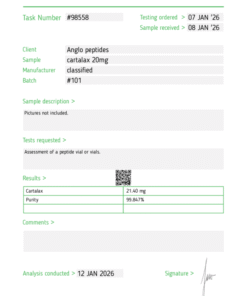
Researchers should use appropriate analytical documentation when
reproducibility is important and should avoid assuming that products
carrying the same commercial name necessarily have identical
specifications.
Related Research Peptides
Researchers interested in short peptides and connective-tissue biology
can also compare this material with other products in the Anglo Peptides
catalogue.
BPC-157 UK
– an experimental peptide with a separate preclinical research history.
BPC-157 + TB-500
– a combination research formulation.
GHK-Cu
– a copper-associated peptide studied in cellular and
extracellular-matrix research.
KPV Peptide
– a separate short-peptide research material.
You can also browse the complete
research peptide collection
to compare additional laboratory materials.
Research Considerations
Experimental peptide research requires careful separation of established
findings from preliminary observations. Results obtained in cell culture
may help researchers investigate mechanisms but cannot automatically be
translated into human outcomes.
Similarly, animal findings require further validation before they can be
considered relevant to human clinical applications.
For this reason, researchers should evaluate primary literature,
experimental methodology and product-specific documentation together.
Ordering Cartalax UK
Before ordering, researchers should review the available specifications
and confirm that the intended purchase is appropriate for legitimate
laboratory or scientific research.
Customers and researchers are responsible for ensuring that their
purchase, possession, handling and intended research activities comply
with applicable laws, regulations and institutional requirements.
Explore additional laboratory materials through the
Anglo Peptides Shop
.
Research-Use Notice
Cartalax products supplied through Anglo Peptides are presented strictly
for legitimate research purposes.
This material is not intended for human consumption, self-administration,
diagnosis, treatment or prevention of disease.
Anglo Peptides does not provide human dosing instructions, administration
protocols, treatment recommendations or medical advice. Researchers are
responsible for ensuring that their activities comply with applicable
legal, regulatory and institutional requirements.
Frequently Asked Questions
What is Cartalax?
Cartalax is the name associated with the short peptide
alanyl-glutamyl-aspartic acid, also known as Ala-Glu-Asp or AED.
What is this peptide researched for?
Research interest includes short-peptide biology, gene-expression
studies, cellular ageing and experimental cartilage or connective-tissue
research.
Is Cartalax clinically proven to repair cartilage?
No. The available evidence does not establish this material as a
clinically proven cartilage-repair treatment. Research findings should
be interpreted according to the experimental model and quality of the
available evidence.
What is the sequence?
PubChem identifies the compound as the tripeptide Ala-Glu-Asp (AED).
Is this an approved medicine?
This product is presented as experimental research material rather than
an approved medicinal product.
Is this product intended for human use?
No. Products supplied through Anglo Peptides are presented strictly for
legitimate research purposes and are not intended for human consumption
or self-administration.


Reviews
There are no reviews yet.