
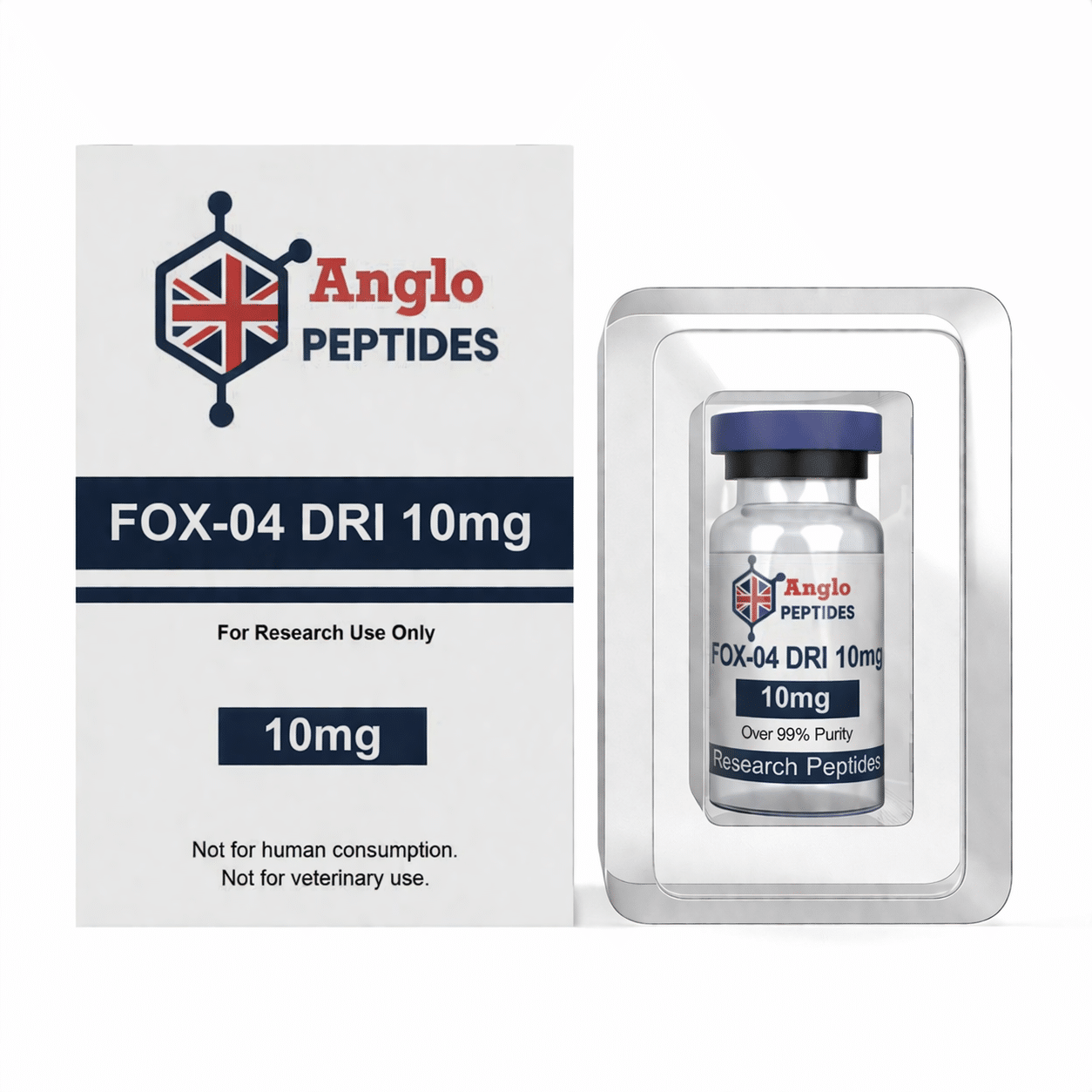


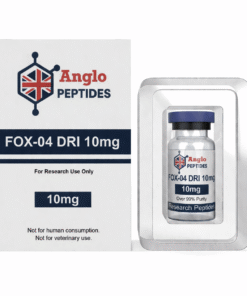

FOX 04 DRI UK – FOXO4-DRI Research Peptide
Anglo Peptides presents
FOX 04 DRI, scientifically written as
FOXO4-DRI, as an experimental peptide for legitimate
laboratory and scientific research. FOXO4-DRI is a retro-inverso peptide
designed to interfere with the interaction between the transcription
factor FOXO4 and the tumour-suppressor protein p53.
Research into FOXO4-DRI has focused particularly on cellular senescence.
Experimental studies have investigated whether disrupting the
FOXO4-p53 interaction can promote apoptosis in senescent cells while
having a comparatively smaller effect on non-senescent cells.
This page provides scientific and product information for research
purposes only. It does not provide human dosing instructions,
administration protocols, anti-ageing treatment advice or guidance for
personal use.
What Is FOX 04 DRI?
FOXO4-DRI is a synthetic retro-inverso peptide derived
from the FOXO4 protein sequence. The D-retro-inverso configuration is
designed to preserve important molecular recognition features while
improving resistance to enzymatic degradation compared with the
corresponding conventional peptide.
FOXO4-DRI became particularly notable through research into the
FOXO4-p53 interaction. In senescent cells, FOXO4 can interact with p53 and
contribute to cellular survival. Experimental FOXO4-DRI was designed to
interfere with this interaction.
The original research demonstrated that the peptide could promote
p53-dependent apoptosis in senescent cells in experimental models.
Researchers can review the original study through
PubMed’s FOXO4-DRI research
.
FOXO4-DRI and Cellular Senescence
Cellular senescence describes a state in which cells permanently or
persistently stop dividing while remaining metabolically active. Senescent
cells can produce a range of signalling molecules collectively referred
to as the senescence-associated secretory phenotype, or SASP.
Because senescent cells can accumulate in ageing and disease-associated
environments, researchers have become interested in compounds capable of
selectively targeting these cells.
FOXO4-DRI is studied within this field because it targets a molecular
interaction involved in the survival of senescent cells.
Importantly, cellular senescence also has beneficial biological roles in
certain contexts, including tissue repair and protection against damaged
or potentially cancerous cells. Consequently, indiscriminate removal of
senescent cells is not necessarily desirable.
How FOXO4-DRI Is Studied
FOXO4 DRI research centres on the interaction between
FOXO4 and p53. Experimental studies suggest that FOXO4 can help maintain
p53 within the nucleus of senescent cells, contributing to their continued
survival.
FOXO4-DRI is designed to compete with this interaction. By interfering
with the FOXO4-p53 complex, the peptide can promote the movement of p53
away from the nucleus and activate apoptosis-related signalling in
susceptible senescent cells.
The 2025 structural study of FOXO4-DRI provided additional molecular
insight into how the peptide interacts with the p53 transactivation
domain. :contentReference[oaicite:1]{index=1}
FOXO4 DRI Research Background
The initial landmark research on FOXO4-DRI investigated whether targeted
disruption of the FOXO4-p53 interaction could selectively eliminate
senescent cells.
In experimental models, FOXO4-DRI induced apoptosis in senescent cells and
produced improvements in several measures of tissue function in aged
mice. These findings established a foundation for further research into
peptide-based senolytic strategies.
The original study should be interpreted as preclinical evidence rather
than proof of an established human anti-ageing treatment. :contentReference[oaicite:2]{index=2}
FOXO4-DRI and Senolytic Peptide Research
A senolytic peptide is an experimental peptide being
investigated for its ability to selectively induce death in senescent
cells.
FOXO4-DRI is one of the best-known peptide candidates in this research
area because its mechanism focuses on the FOXO4-p53 survival pathway.
Research has investigated FOXO4-DRI in several experimental cell types,
including fibroblasts and chondrocytes. A study involving human
chondrocytes found that FOXO4-DRI reduced senescent-cell populations in
expanded cell cultures, although the researchers noted that additional
investigation was required to establish its broader utility. :contentReference[oaicite:3]{index=3}
FOXO4-DRI and Molecular Research
The FOXO4-p53 pathway provides a useful model for investigating the
molecular mechanisms that allow senescent cells to resist apoptosis.
FOXO4 is part of the forkhead box O family of transcription factors,
which participate in diverse cellular processes. p53 is a major regulator
of cellular stress responses, DNA damage and apoptosis.
Studying their interaction therefore allows researchers to investigate
relationships between cellular stress, senescence and programmed cell
death.
Recent structural research has further characterised the interaction
between FOXO4-DRI and the p53 transactivation domain, providing additional
information for future peptide-design research. :contentReference[oaicite:4]{index=4}
FOXO4-DRI Research Areas
Scientific investigation involving FOXO4-DRI includes:
- Cellular senescence
- Senolytic peptide research
- FOXO4-p53 signalling
- Apoptosis research
- Ageing biology
- Cellular stress responses
- Peptide-protein interactions
- Experimental tissue biology
These categories describe areas of laboratory research and should not be
interpreted as established therapeutic indications.
FOXO4-DRI UK Product Information
Researchers considering FOXO4-DRI UK should review the
specific product information provided on this page before ordering.
Product considerations may include available quantity, presentation,
sequence information, storage requirements where provided and applicable
fulfilment arrangements.
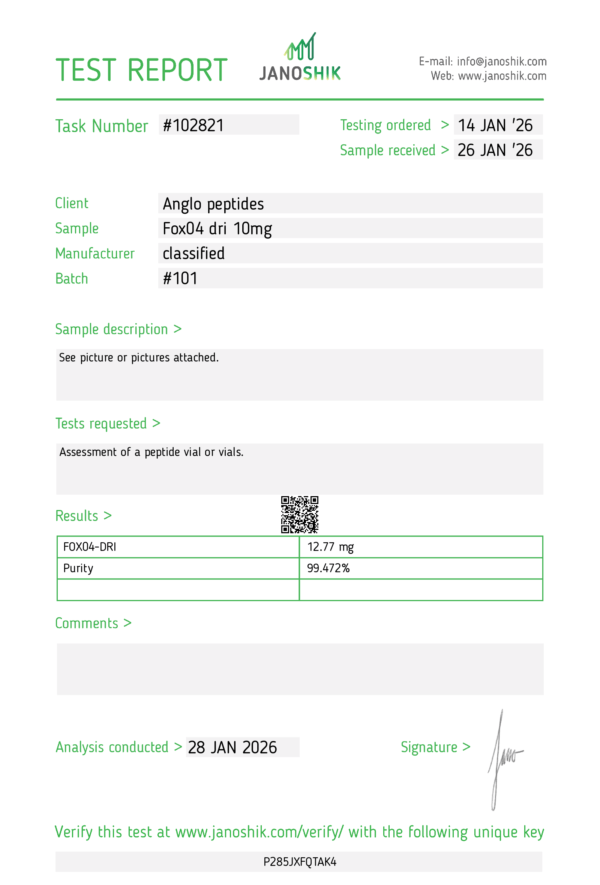
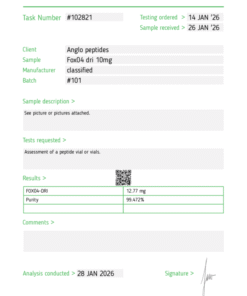
Researchers should verify the exact specifications and analytical
documentation of the material being evaluated and determine its
suitability for their own validated laboratory procedures.
For delivery and fulfilment information, review the
Anglo Peptides Shipping Policy
.
FOXO4-DRI in Preclinical Research
FOXO4-DRI has been investigated in several preclinical models beyond the
original fibroblast research.
Studies have examined the peptide in areas including cartilage biology,
vascular ageing, reproductive biology and other models involving cellular
senescence.
A 2026 study investigated FOXO4-DRI in aged and experimentally aged mice
and reported effects involving senescent endothelial cells and the
FOXO4-p53 pathway. Such findings add to the preclinical research base but
remain animal and laboratory evidence. :contentReference[oaicite:5]{index=5}
Researchers should therefore distinguish experimental findings from
evidence obtained through controlled human clinical trials.
FOXO4-DRI and Related Research
Researchers interested in cellular ageing, senescence and experimental
peptide biology can also explore related materials within the Anglo
Peptides catalogue.
MOTS-c peptide
– a mitochondrial-derived peptide investigated in metabolic and
cellular research.
NAD research product
– relevant to research involving cellular metabolism and redox biology.
Methylene Blue UK
– a redox-active research compound investigated in cellular and
mitochondrial research.
GHK-Cu
– a copper-associated peptide investigated in cellular and
extracellular-matrix research.
Explore the complete
research peptide collection
for additional laboratory materials.
Understanding FOXO4-DRI Research
FOXO4-DRI is an experimental peptide and should be evaluated according to
the quality and limitations of the available scientific evidence.
Findings from cell cultures and animal models can provide valuable
mechanistic information, but they cannot by themselves establish human
safety, efficacy or an appropriate clinical application.
The distinction is particularly important for senolytic research because
cellular senescence can have both beneficial and detrimental roles
depending on biological context.
Research and Safety Considerations
FOXO4-DRI is not presented as an approved medicine or established
anti-ageing treatment. The current evidence base remains predominantly
experimental.
Research into senolytic strategies also highlights the importance of
selectivity. Eliminating senescent cells indiscriminately could potentially
interfere with biological processes in which senescence has a beneficial
function.
Researchers should therefore use appropriate experimental controls and
institutional safety procedures when investigating FOXO4-DRI.
Ordering FOXO4-DRI UK
Before ordering, researchers should review the available product
information and confirm that the intended purchase is appropriate for
legitimate laboratory or scientific research.
Customers and researchers are responsible for ensuring that their
purchase, possession, handling and intended research activities comply
with applicable laws, regulations and institutional requirements.
To explore additional research materials, visit the
Anglo Peptides Shop
.
Research-Use Notice
FOXO4-DRI products supplied through Anglo Peptides are presented strictly
for legitimate research purposes.
This product is not intended for human consumption, self-administration,
diagnosis, treatment or prevention of disease.
Anglo Peptides does not provide dosing instructions, administration
protocols, anti-ageing regimens, treatment recommendations or medical
advice. Researchers are responsible for ensuring that their activities
comply with applicable legal, regulatory and institutional requirements.
Frequently Asked Questions
What is FOX 04 DRI?
FOX 04 DRI, more commonly written as FOXO4-DRI, is a synthetic
retro-inverso peptide designed to interfere with the interaction between
FOXO4 and p53. It has been investigated primarily in cellular senescence
and senolytic research.
What is FOXO4-DRI researched for?
Research has investigated FOXO4-DRI in areas including cellular
senescence, apoptosis, FOXO4-p53 signalling and experimental senolytic
strategies.
Is FOXO4-DRI a senolytic peptide?
FOXO4-DRI is described in scientific literature as an experimental
senolytic peptide because studies have investigated its ability to induce
apoptosis in senescent cells.
Has FOXO4-DRI been clinically proven as an anti-ageing treatment?
No. The principal evidence for FOXO4-DRI comes from laboratory and animal
research. These findings should not be interpreted as proof of an
established human anti-ageing treatment.
How does FOXO4-DRI work in research?
Experimental research indicates that FOXO4-DRI interferes with the
FOXO4-p53 interaction, which can promote p53-dependent apoptosis in
susceptible senescent cells.
Is this product intended for human use?
No. Products supplied through Anglo Peptides are presented strictly for
legitimate research purposes and are not intended for human consumption
or self-administration.
Where can I find related research products?
Explore the
MOTS-c peptide
product or browse the complete
research peptide collection
.
Explore FOX 04 DRI UK
Review the available FOXO4-DRI product information and explore related
research materials within the Anglo Peptides catalogue.

Reviews
There are no reviews yet.